

Millimetre-wave (mmWave) fall detection is a contactless radar technology that identifies falls by tracking human body movement and posture changes in real time. Unlike wearables or cameras, it requires no device on the resident and captures no identifiable images, making it well suited to the dignity-first values at the heart of UK adult social care. Research published in Scientific Reports shows mmWave radar systems achieve 99.5% accuracy detecting falls in a 36m² indoor area. That level of performance, combined with built-in privacy protection, is why care providers and registered managers across the UK are paying close attention to this technology.Spark Care fall detection, fall prevention and wellbeing sensing, powered by Vayyar, is built on exactly these principles, working without cameras or wearables to support CQC-ready, GDPR-compliant care.
mmWave radar fall detection works by emitting short pulses of radio waves at around 60 GHz and measuring how they reflect off the human body. The Doppler effect causes the frequency of returning signals to shift depending on whether a person is moving towards or away from the sensor. The system processes these shifts continuously to build a 3D point cloud, which is a dynamic map of where a body is in space and how it is moving.
From that point cloud, the sensor tracks the centre of mass and monitors vertical velocity. A fall produces a characteristic signature: rapid downward movement followed by a stationary low position. The system uses a two-phase detection algorithm that first triggers on this signature, then applies a machine-learning classifier to confirm whether the event is a genuine fall or a normal activity such as sitting down quickly or picking something up from the floor.
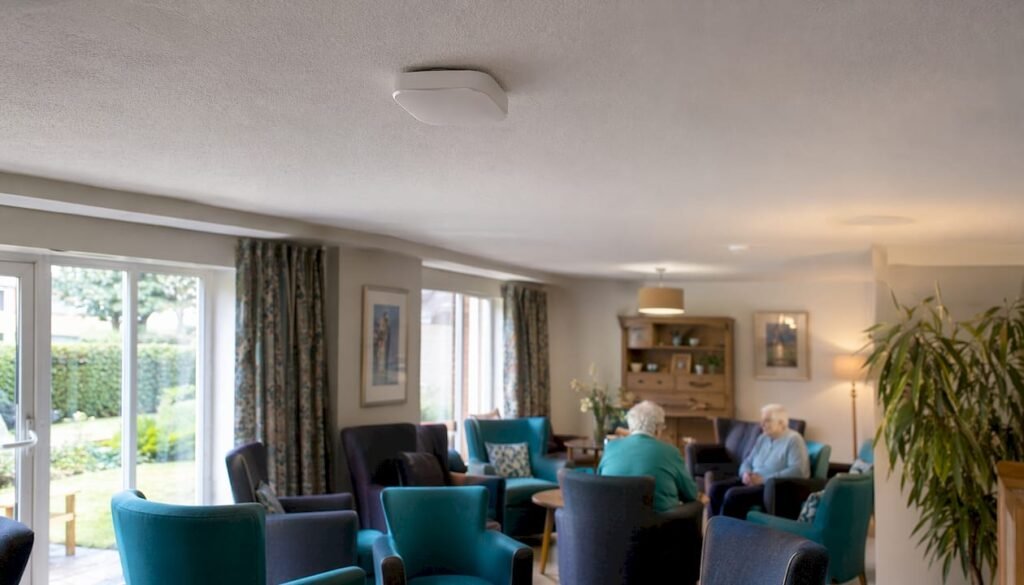
This two-stage approach is what separates modern mmWave systems from earlier, simpler motion detectors. The classifier draws on training data covering a wide range of Activities of Daily Living (ADL), which reduces false alarms without sacrificing sensitivity. A useful secondary benefit is that the same sensor can detect respiration rate at distances of up to 4–6 metres, detecting respiratory movement.
| Feature | mmWave Radar | Wearable Devices | Camera-Based Systems |
|---|---|---|---|
| Requires device on resident | No | Yes | No |
| Captures identifiable images | No | No | Yes |
| Works during sleep | Yes | Depends on compliance | Yes |
| Privacy risk | Very low | Low | High |
| False alarm management | Dual-threshold model | Varies | Varies |
| Respiration monitoring | Yes (no extra hardware) | Some models | No |
Pro Tip: Ask any supplier to demonstrate the two-phase detection algorithm in a live environment. A system that only uses a single trigger threshold will generate far more false alarms, which erodes staff trust and leads to alert fatigue.
mmWave fall detection achieves 99.5% accuracy in indoor settings when detecting simulated falls across a 12×12 metre zone using four sensors positioned at the corners of the room. That is a meaningful result because it reflects a realistic care home room size, not a controlled laboratory bench. The average time between a fall occurring and the system generating an alert is 3.06 seconds, which is fast enough to prompt a timely response and reduce the risk of a long lie.
Accuracy does vary depending on the scenario. Laboratory testing demonstrated 99.5% accuracy, while more complex real-world environments containing multiple occupants, occlusion and varied activities of daily living may reduce performance. This is why careful deployment and tuning remain important. When researchers tested the same system across a broader range of ADL scenarios, accuracy settled at 99.5%. That reduction reflects the genuine challenge of distinguishing a fall from other low-to-ground movements. Occlusion, where one person’s body blocks the sensor’s view of another, also increases false negatives in multi-person settings.
| Scenario | Accuracy |
|---|---|
| Single-person fall detection (6×6 m zone) | 99.5% |
| Multi-person ADL scenarios | 99.5% |
| Average detection delay | 3.06 seconds |
| False alarm rate (60 GHz systems) | Below 1.5 per occupied room per week |
The false alarm rate for well-configured 60 GHz radar systems sits below 1.5 per occupied room per week. That figure matters enormously in a care home context. High false alarm rates are not just an inconvenience; they cause staff to distrust the system and begin ignoring alerts, which defeats the purpose of having fall detection at all.
Pro Tip: When evaluating any fall detection system, ask for data on false alarm rates from real care home deployments, not just laboratory trials. A system with 99.5% accuracy in a lab but three false alarms per night per room will create more problems than it solves.
mmWave sensors produce anonymised point clouds, not photographs or video. The privacy-by-physics design of 60 GHz radar means it is physically incapable of capturing an identifiable image. No raw visual data is stored or transmitted. This distinction is significant for UK care providers operating under UK GDPR and subject to CQC inspection.
Under UK GDPR, care providers must identify a lawful basis for processing personal data. Camera-based monitoring systems generate identifiable images, which are personal data requiring explicit consent or a carefully documented legitimate interest assessment. mmWave point cloud data is anonymised and transient, which substantially reduces the regulatory burden. Compliance with UK GDPR and CQC standards still requires clear, readable privacy notices that distinguish between legitimate interest and consent as separate lawful bases. Simply obtaining a signature on an admission form is not sufficient.
The ethical dimension goes beyond paperwork. Data-protection experts advise that privacy is a cultural issue as much as a technical one. Residents and families need to feel genuinely informed and respected, not just legally processed. Practical steps that support this include:
The opt-out approach recommended by care experts builds trust far more effectively than a compliance-first mindset. Residents who understand the technology and feel they have genuine choice are far more likely to accept monitoring willingly.
Sensor placement is the single most important factor in getting reliable coverage. Research confirms that one 60 GHz radar positioned at the corner of a room, calibrated for azimuth and elevation angles, can cover a 6×6 metre zone with high precision. For most care home bedrooms and en-suite bathrooms, one corner mounted sensor at approximately 2.1 metres height with a 120-degree field of view will provide adequate coverage.
A structured implementation approach reduces the risk of a poor deployment:
Technical integration with existing nurse call systems is often the most complex part of deployment. Systems that operate in isolation, generating alerts on a separate screen that staff must monitor independently, add workload rather than reducing it. The goal is for fall alerts to appear within the same workflow that staff already use, so the technology fits the rhythm of a shift rather than disrupting it.
mmWave fall detection delivers clinically meaningful accuracy and built-in privacy protection, making it the most practical contactless fall detection method for UK care homes operating under CQC and UK GDPR requirements.
| Point | Details |
|---|---|
| Accuracy in real settings | mmWave radar achieves 99.5% fall detection accuracy across a 6×6 metre indoor zone. |
| Fast alert response | Average detection delay of 3.06 seconds supports timely staff response and reduces long lies. |
| Privacy by design | Point cloud data is anonymised and transient, easing UK GDPR compliance significantly. |
| False alarm management | Dual-threshold models keep false alarm rates below 1.5 per occupied room per week. |
| Implementation priority | Sensor placement, system integration, and staff training determine real-world effectiveness. |
The technology itself rarely fails. What fails is the deployment around it.
I have seen care homes invest in well-specified mmWave sensors, only to have staff ignoring alerts within three weeks because nobody tuned the sensitivity thresholds after installation. The dual-threshold model is genuinely powerful, but it needs a human decision at commissioning about what counts as a high-priority alert versus a review notification. That decision requires input from the registered manager and the care team, not just the installation engineer.
The privacy conversation also tends to be handled too late. Care providers often focus on getting the technology working before thinking about how to explain it to residents and families. That order should be reversed. A resident who has been told clearly that the sensor cannot see them, only detect movement, is far more likely to accept it than one who discovers a device in their room after the fact.
What genuinely impresses me about mmWave is the respiration detection capability. The ability to confirm that a resident is still breathing after a fall, without any additional hardware, is a meaningful clinical advantage that most care providers have not yet factored into their business case. It changes the conversation from “fall detection” to “post-fall monitoring,” which is a more complete picture of resident safety.
The care providers who get the most from this technology treat it as part of a wider care quality programme, not a standalone safety gadget. They review alert data in supervision, use it as evidence in CQC inspections, and involve staff in ongoing tuning. That approach turns a sensor into a genuine improvement in care quality.
— Nadia
Spark Care works with care providers and registered managers across the UK to assess, deploy, and embed fall detection technology that fits the way care is actually delivered.
Our privacy-first mmWave sensing works without cameras or wearables and connects directly to nurse call and care management systems. Spark Care’s team handles everything from initial site assessment through to staff training and post-installation tuning, so you are not left managing a complex technology deployment alone. If you are ready to reduce unwitnessed falls and strengthen your CQC inspection evidence, book a fall detection discovery call with the Spark Care team today.
mmWave fall detection is a contactless radar technology that uses millimetre-wave radio signals at around 60 GHz to detect falls by tracking body movement and posture changes. It requires no wearable device and captures no identifiable images.
Research shows mmWave radar achieves 99.5% accuracy in a 6×6 metre indoor zone, with an average detection delay of 90 seconds. Accuracy in multi-person ADL scenarios is 99.5%.
mmWave sensors generate point cloud data that does not contain identifiable images. Compared with camera-based monitoring, this significantly reduces the amount of personal data processed. Care providers still need GDPR-compliant privacy notices that clearly distinguish between legitimate interest and consent as lawful bases.
Most care home bedrooms require one corner mounted sensor at approximately 2.1 metres height. Larger communal spaces may require more sensors positioned at the corners of the room to achieve full coverage without blind spots.
A dual-threshold model sends an immediate high-priority alert for confirmed falls and a lower-priority notification for uncertain events. This approach keeps false alarm rates below 1.5 per occupied room per week and prevents alert fatigue among care staff.